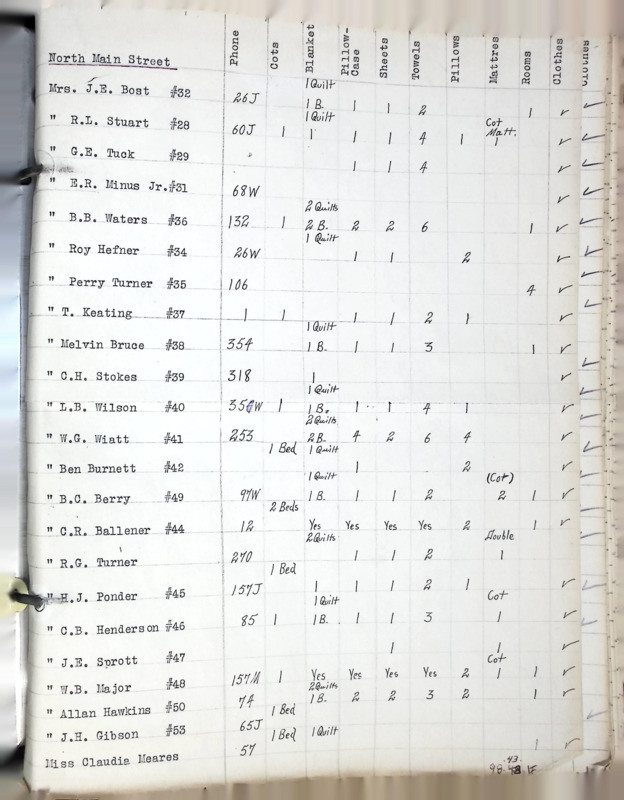
This information came from a "Day-Book" owned by Henry Samuel Gibson (1816-1891), a blacksmith, shoe cobbler, and general store owner. He kept this "Day-Book" in which he noted births, the accounts of his blacksmith shop and records of groceries and general merchandise which he sold. The business was located in the area of what is now the Gibson Ball Field off of Hwy. 14, north of Greer, SC.
The Harmonizing Quintet was an active group in the 1940s that often performed on WSPA Radio shows, such as Farmer Gray and the Gospel Hour.
Members: Henry Jones, Henry Black, "Geek" Johnson, David Murphy, Richard Smith, Stenson Murphy
David Murphy lived in Greer on Hampton Road.
In the Greer City Directory of 1915, there are 4 black neighborhoods listed: Greentown, Needmore, Maple Creek, and Slabtown, which would be later known as Sunnyside. The Needmore community is described as "a colored people settlement, lies half mile north of city on National Highway" (W. Poinsett Avenue), which was the major road for travel between Greenville and Spartanburg. One of the outstanding citizens of the community was James S Jenkins Jr., known as Jim, who was a master brick mason. Mr. Mason, who moved to Greer in 1898, worked on the original manholes along Emma Street (W. Poinsett St.) and is credited with building the brick smoke stacks of Franklin Mill in 1900. He was also a charter member of Maple Grove Baptist Church and worked to raise funds for the Bailey View Academy in Greentown so that African-American children would have a school to attend in Greer.
After Bailey View burned in 1924, Dunbar was built in Sunnyside, but the Needmore community desired a school closer to their homes. In 1936, Greer School District authorized a two-teacher school for African-American children if the community would provide the land and building. In 1937, property was donated by B.D. Henson for that purpose, and the community raised funds. In the midst of the Depression which was followed by WWII, the school district failed to act, citing lack of money to proceed. It was not until the 1950s that a school was opened in the neighborhood in a war surplus Quonset hut that was moved to the site on Canteen Avenue. The neighborhood children attended this school for 4 or 5 years until Lincoln, between Greer and Taylors, was completed in the mid-1950s.
After the school closed, the Quonset hut was used by an African-American men's club. Citing problems with the club, the city purchased the land in 1959, removed the old barracks, and constructed the Needmore Center as part of the Recreation Department building program the also produced the Tryon Street Park and Recreation Center. The city had asked the public to vote for a $100,000 bond to initiate the building program and had been turned down. The Joycees pushed for passage, and the community responded by passing it the second time it was on the ballot. Land was added several times to expand the Needmore Park area. Land for the tents court was bought from the Harrison family.
John Henry Lyles, an African-American teacher at Lincoln and later Greer Middle School, was hired part-time to run an after-school program. One of his sources of funds for programs was the concession stand at the center. Another school teacher, Benny Brown, was also a director of the center.
When the center fell into disrepair, there was talk of removing the building. The community urged the city to keep the center as a much-needed recreational and educational facility for their neighborhood, prompting Council Woman Martha King to put her neighborhood redevelopment funds into the renovation of the center. Phyllis Wheatley Center took on the programming at the center until a disagreement on funding caused this organization to leave and the city to take on the operation of the center.
Today there is an active senior citizen program that is attended by both African-Americans and whites. Senior Action sends lunch meals, and programs are planned by a director. In 1997, Ms. Agnes Davis Young, Senior Program Manager, was recognized by the South Carolina General Assembly for "her outstanding dedication as the Director of Senior Citizens, City of Greer."
The donation of computers to the center helped young people in the after-school program. Other programs make use of the center, such as the children's theater that often holds its auditions in the large meeting room. It is also a city polling location. Located in the middle of the Needmore Community, the center is an easy walk for most of its citizens and provides an identifying landmark for the neighborhood.
Although Ella Jane Nesbitt was born in Asheville, NC, her roots are Greer. Ella and her sister came to live with their grandparents on Stokes Street in the house which their mother's sisters had bought for their parents. One of the aunts was a schoolteacher who taught at a rural black school. As was the custom, she lived with a family through the week and then came home to Greer on weekends.
When Ella was in junior high at Dunbar, an aunt in Washington, D.C. requested that Ella come live with her to assist her during a period of poor health. In Washington, Ella went to vocational school and studied cosmetology. In 1947, her daughter Norma Jean was born. But when Norma Jean was 3 months old, Ella returned to the family home on Stokes Street and began to fix hair. A SC licensed cosmetologist, she operated the Nesbitt Beauty Shop from 1947 until 2006 when she decided to retire and not renew her business license with the city of Greer.
Ella says that in the early day, people had their hair done mainly for special occasions. Line Huff fixed hair in her home in the same Sunnyside neighborhood. In Needmore, Helen Thompson, also a licensed cosmetologist, had a shop in the rear of the house where her sister owned the Thompson Funeral Home on Forest Street.
When Ella started, she fixed hair in the house until the family built her a room by enclosing the end of the porch for her shop. After a board inspector told her that she needed a restroom for her customers, she enlarged the shop by adding a room to the porch space. Then she had space for 2 chairs and a partner.
Ella says that she was happy working solo. One day Frances Miller, who lived across the street and worked at another shop in the neighborhood, asked if she could join Ella. Not wanting to make too quick a decision, Ella had to think about it. But Ella's cousin urged her to take Frances into the shop. "She'll make a good partner." Ella admits that although things weren't always perfect, they did indeed make good partners. "We got along fine. Some people moved from my chair to hers, but some of her people moved to my chair." They were partners for 50 years.
Customers came from Greer, Duncan, and Wellford. Some of her customers were Dunbar teachers. Mrs. Callahan, who lived across the street at the Callahan Funeral Home, was a first grade teacher who had Ella style her hair. Ella remembers Mrs. Vance, who also taught at Dunbar. "She lived with our family while teaching school. That was done then. Families kept the teachers. She had me do her hair."
Ella says, "Most women came for a wash, press, and curl." She can't remember the cost when she started, but thought that it was about 75 cents or maybe $1.00. She still has her pressing combs for straightening hair and the different size curling irons to put back some curl. The combs were placed into the box of a small electric heater. After gas was run to the house, she used a gas jet where she laid the pressing comb on top to heat very quickly. She then pulled the comb through the customer's hair away from the scalp to avoid burns. Ella's gas jet is a small appliance made decorative by placing the heating element on the top of a silver turtle's back.
When asked what she enjoyed most about her career, she says, "I enjoyed the job-- period. I enjoyed people and the work." In 1976, she was awarded the SC State Cosmetology "Woman of the Year." The plaque that hangs proudly in her shop says, "in recognition of your contribution, hard work, and unselfish endeavors." She is proud of this honor, but she is most proud of her girls: daughter Norma Jean Nesbitt Givens who earned a doctorate, a granddaughter who is also a teacher, and two great granddaughters.
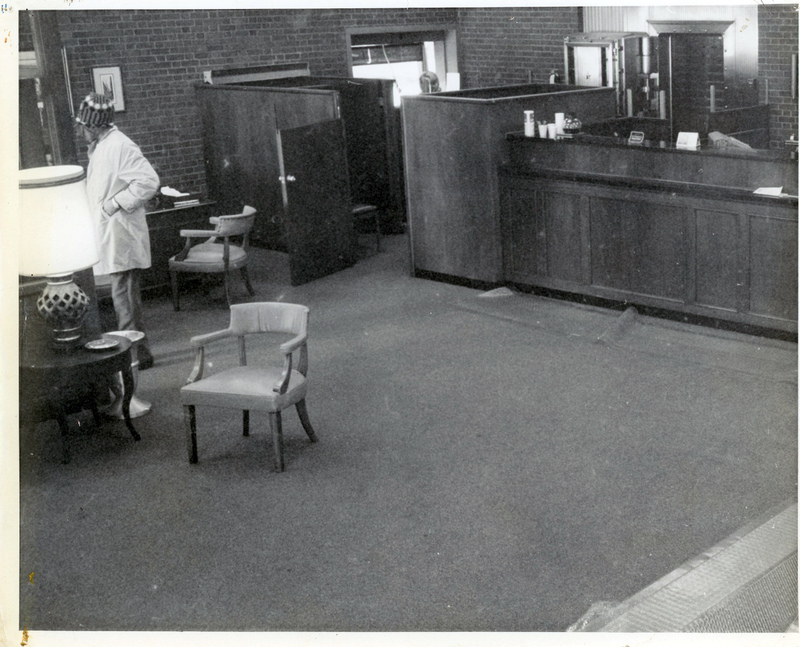
Black and white original photograph of a bank robbery in progress; man in coat and ski mask is turned away from the teller and moving toward the exit, taken by an automated film camera in the bank. On top left corner is written in ball-point pen a small number "11." On the back is written a small number "6." The depositor, Paul Green, thinks he received these two photographs from the FBI while investigating the robbery.
Black and white original photograph of a bank robbery in progress; man in coat and ski mask holding pistol toward a teller, taken by an automated film camera in the bank. On top left corner is written in ball-point pen a small number "10." On the back is written a small number "29." The depositor, Paul Green, thinks he received these two photographs from the FBI while investigating the robbery.
Book: Trotting Sally
The Roots and Legacy of a Folk Hero
Author: John Thomas Fowler
Signed by the author 3/22/2014
John Thomas Fowler tells two tales; the story of Trotting Sally, a once familiar street musician to residents of the upcountry of South Carolina and Western North Carolina;
and the real man few knew-George Mullins, who lifted himself out of slavery and built a new life, brick by brick. Fowler flushes out the public figure and reveals the private man behind one of the Carolina's most famous and elusive turn-of-the-century African Americans.
A letter from Mama to Ruth Sullivan. We know it is sent to Ruth because her mother almost always starts the letters to Ruth with "Toots." The letter is undated.
An undated envelope from Chicora Magazine to Ruth Sullivan. It is unknown whether Chicora Magazine did send something to Ruth or someone used the envelope to send Ruth a letter.
A letter from "R" to Ruth Sullivan Hawkins. It is unknown who "R" is at the present time. The envelope and the letter are undated. It is addressed to "Mrs. Harper Hawkins" so it was sent after she married Harper Hawkins.
An envelope for a letter from "R" to Ruth Sullivan Hawkins. It is unknown who "R" is at the present time. The stamp was ripped from the envelope. It is addressed to "Mrs. Harper Hawkins" so it was sent after she married Harper Hawkins.